
Kharaxi Brood
A ship is a tunnel that moves. The Brood were not the first people to say so, but they were the first to build one.
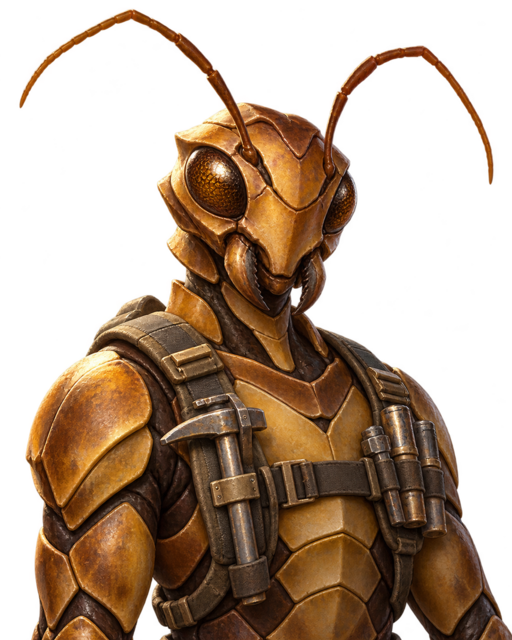
In the game
Insectoids adapted to excavation and collective construction. Superb practical traditions, slow abstract science.
They breathe air and live on land, and need food, power and somewhere to sleep like anybody else.
Begins already knowing: Vacuum Excavation.
What they are
Chitinous insectoids, low to the ground, with four working limbs and the strength to use all of them. They tolerate dark, pressure, heat and foul air to a degree that other peoples find difficult to watch, and they are nearly impossible to disorient underground.
A Kharaxi feels a draught the way other people feel a wound. Open sky is the uncomfortable condition and a sealed habitat is the natural one, which is why a Brood colony asks ten per cent less power of its life support than anybody else's: they are not being kept alive against their instincts, only against the vacuum.
The world that made them
A world whose surface was the dangerous place. Abrasive storms, a star that could not be looked at safely, and weather that took the top off anything built in the open. Everything that mattered in Kharaxi history therefore happened underground, in galleries cut by hand and held up by craft passed from one generation to the next.
They have no tradition of looking at the sky. Where the Caelari built an observatory and waited four centuries, the Brood dug, and found out what the rock would hold by finding out what it would not.
The Hundred Shafts
The Brood's founding work is not a theory. It is a system of shafts, galleries and air-ways, extended continuously for longer than most peoples have had writing, in which every method still in use was established by trying it, recording what held and what came down, and handing the result to the next pair of hands.
It produced the best practical engineers in the galaxy and almost no abstract science whatsoever. A Brood engineer can build a reactor whose principles they could not derive, and will then keep it running without fault for sixty years — which is not the same skill and is frequently the more useful one.
It also means they arrive at every idea last. Research runs at half the rate of anybody else's, and the Brood have never once treated this as a humiliation. They got to space on method rather than insight, and they got there with twice as much of everything material as the people who beat them to the mathematics.
Vacuum Excavation is theirs from the first turn. Vacuum, to the Brood, is simply another kind of bad air, and bad air is a solved problem.
How a Brood decides
A brood is not a parliament and does not pretend to be. Work is allotted: the gallery that needs cutting is cut, by whoever is nearest to it with the trade for it, and the question of whether it ought to be cut was settled by whoever has been cutting galleries longest.
To outsiders this looks like obedience. It is closer to impatience. A Brood will hear a proposal once, and if it cannot be stated as a thing to be built it will not be heard again.
They are territorial about seams specifically. A Brood that will shrug at a lost moon will go to war over an ore vein, and has.
What is theirs alone
Every people has the same buildings and the same technology tree. These are the exceptions — the things only this one has, or has differently.
- A quarter more of everything material
- Minerals, production and food all run at 125%. It is one advantage stated three times, and because production converts stored minerals, it compounds every single turn.
- Cheap air
- Life support draws 10% less. A sealed habitat is where a Kharaxi would rather be, so holding a dead rock costs them less grid than it costs anybody else.
- Vacuum Excavation from the first turn
- They begin knowing how to dig where there is nothing to breathe.
Playing them
The opening
Seams first, and more of them than feels reasonable. Your 125% is on the yield, so every mineworks you put on good rock is worth a quarter more than the same building anywhere else in the galaxy, and the compounding starts the turn it opens.
You begin with an extra engineer, and an engineer in a reactor or a works is worth half again as much as a colonist in one. Put them where the multiplier already is.
The real decision
Research is halved, and the temptation is to abandon it. Do not: the habitation line and Warp Theory are not optional, and at half rate they arrive late enough to cost you the map while you are still comfortably the richest empire in it.
The correct shape is one laboratory early and never fewer, aimed squarely at sealed habitation and the drive. Everything else you will get to eventually, and eventually is fine when you can build three of whatever it turns out to be.
Where you win
On rock nobody else wants, early, in quantity. Cheap life support and vacuum digging from turn one mean a Brood can hold moons and asteroids while the Conclave is still deciding whether they are interesting. Take the ore, build the hulls, and present everybody with a fleet they have to answer before they have finished theorising about one.
Everything in the guide applies to all six peoples; the above is what changes for this one.
Against the other five
- Caelari Conclave
- They will know everything first and be able to build none of it. Keep them talking and keep digging.
- Sepharai Shoal
- A people who cannot stand on four fifths of the galaxy are no threat to a people who live in the rock. Leave them their shelf.
- Varkesh Host
- The one neighbour who holds a bad world as cheaply as you do, and who will win any ground fight you start. Take the rocks they have not reached yet rather than the ones they hold.
- Maketh Assembly
- Your mirror: they settle anything, like you, and they pay for every citizen in minerals. Out-dig them, because that is the only race either of you is running.
- Nemora Bloom
- They will not break ground, which means every seam on a shared world is yours for the asking. They are also nearly defenceless, which has occurred to other people before it occurred to you.