
Sepharai Shoal
They reached orbit without ever lighting a fire.
In the game
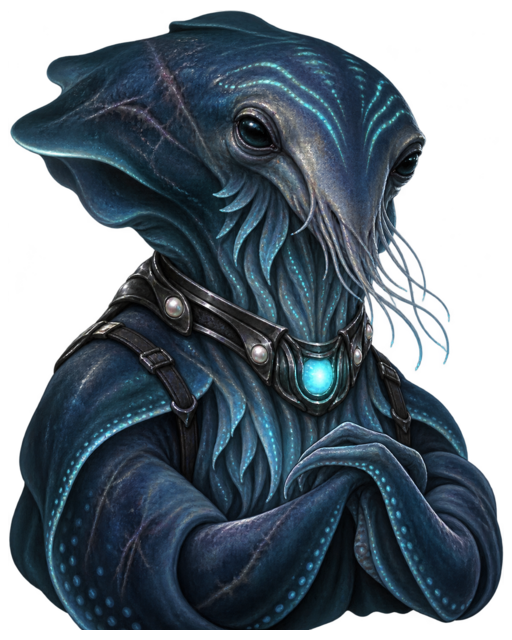
Soft-bodied people who never left the water. They farm the shallows and tap the vents, and cannot set foot on dry land at all.
They live under water. Dry ground is the hostile place for them, and they build to fix that.
Begins already knowing: Hydroponics.
What they are
Soft-bodied people of the shelf and the deep water, with no use for air and no way of surviving in it. The Shoal cannot set foot on dry land — not as a reluctance or a cultural prohibition, but as a fact about their bodies. Dry ground is the hostile place, and the rest of the galaxy is almost entirely dry ground.
They breed in broods, in water that does the carrying for them, which is why a Shoal population grows half again as fast as anybody else's. They are also harder to kill than they look: a people with no skeleton to break, defending a floor they know by current and sound, give ground slowly.
The world that made them
A shelf world. Shallows and kelp over most of the sunlit floor, reefs where the rock came up, vent fields along the fractures, and trenches going down into pressure that even the Shoal needed engineering to work in.
Everything in their civilisation came off one of those five kinds of ground, and their whole technology is legible from the list. They farm the shallows. They grow their buildings out of coral rather than cutting them out of stone. They take their power off living vents. And the richest ore they have ever found is at the bottom of the trenches, which is why Abyssal Engineering exists at all.
The problem of fire
No people in the galaxy had a harder start, and the reason is simple enough to state in a sentence: under water, nothing burns. The Shoal had no forge, no smelting hearth, no kiln and no combustion engine, and every one of those is a step that every other people took without noticing it was a step.
What they had instead was chemistry done in solution, pressure as a tool rather than a hazard, material they could cultivate into the shape they wanted, and heat they could take off a vent without ever making any. Their first furnace was a capped smoker with ore fed into it. Their first factory was a reef grown to purpose over three generations. It took them an age longer than anybody else to reach orbit, and when they did, they arrived with a toolkit nobody could borrow.
The Deep Song, and what it cannot carry
Shoal memory is sung. Water carries a voice further and more faithfully than air ever did, and a thing known to the Shoal is a thing that has been put into the song and is sung in the same words by every terrace on the floor. It is why their broadcast halls are spires of resonator vanes and why order keeps itself better among them than it has any right to.
It has one hard limit, and the Shoal are clear-eyed about it: no song teaches a trade. A wright, an engineer, a soldier — every one of those has to be made by somebody failing at the work in conditions that can be allowed to go wrong, which is what the rehearsal pools are for and what a barracks reef is for. A pre-warp shoal could sing its entire history and still not produce a single warrior without building the place that makes them.
Their law works the same way: a grievance is heard out loud, at the bench of a moot reef, before it is allowed to become a grudge. It is not gentleness. It is a people who know exactly how long a grudge survives in a medium where everybody can hear everything.
Taking the sea with them
The Shoal's history since reaching space has been one problem stated over and over: there is almost nowhere to go. Water is about eight per cent of the ground in a galaxy and none at all of any moon or asteroid, so a Shoal empire that expands the way a land people expands stops after two systems.
Their answer is the most audacious piece of engineering any people has committed to. A Tidewall is a watertight ring driven into dry ground with the sea let in over it: where it stands, land becomes shallows, and six tiles of a hostile world become country the Shoal can live in and work. It is how they reach a moon at all.
A Deepshaft goes further and does not undo itself. Sunk until the rock below runs warm, with the heat let up through the ice above, it rots a frozen world's ice sheets into shallows a hex at a time — permanently. That is not weather being held off. It is a world being changed, and the Shoal have changed several.
What is theirs alone
Every people has the same buildings and the same technology tree. These are the exceptions — the things only this one has, or has differently.
- Caisson Works, and the Tidewall it unlocks
- The one structure a water people may raise on land: it floods the six hexes around it without the ground losing what it held. No other people can research it, and for the Shoal it is not a convenience — it is the whole of how they reach anywhere.
- Core Heating, and the Mantle Bore
- Melts a frozen world into a warm sea, one hex at a time, and it does not thaw back. A dead white world becomes Shoal country for good.
- Abyssal Engineering
- Hulls, tools and people that hold together under crushing pressure. Trenches stop being off limits, and the ore in them is the richest a water world has.
- Half again the growth
- They breed faster than anybody, and the water does the work. It is their compensation for a map that is almost all closed to them.
Playing them
The opening
Kelp weirs on living ground, dredges on the richest silt, and a vent capped for power as early as you can. You begin knowing hydroponics, so the Bloom Vats are available from turn one — but a weir on a kelp forest beats a vat every time, and vats are for the dead seas you will settle later.
Then housing, immediately, and more of it than you think you need. Growing half again as fast as everybody else is only an advantage if there is somewhere for them to go; a Shoal that runs out of terraces has turned its one great gift into unrest.
The real decision
Caisson Works costs 300 and sits behind Hostile Seals, and the single most common way to lose with the Shoal is to research it when you finally need it rather than before. Until it is done, every world in the galaxy that is not already wet is simply not available to you, and the other five peoples are not waiting.
Plan the whole middle game around it: Hostile Seals, then Caisson Works, then Abyssal Engineering for the trench ore that pays for the rest. Core Heating comes later and changes a frozen system into a homeland.
Holding what you settle
You are modestly tougher on the ground than most — a tenth better at defending it and a tenth harder to kill — and that is enough to make a settled Shoal floor expensive to take, especially with a stinging reef halving everything thrown at it from orbit. It is not enough to attack with. The Shoal win by occupying places nobody else can use and being impossible to shift out of them.
Everything in the guide applies to all six peoples; the above is what changes for this one.
Against the other five
- Caelari Conclave
- No conflict of interest at all: they want the dry ground and you want the water. The most natural friendship in the galaxy.
- Kharaxi Brood
- They live in the rock and you live over it. Share a world happily until one of you wants the same vent field, which eventually one of you will.
- Varkesh Host
- They can settle the hostile worlds you have to flood first, and they will take a Shoal floor if they land on it. Keep them off the shelf.
- Maketh Assembly
- Indifferent to water, indifferent to everything. They will settle the dry half of every world you flood and never once discuss it.
- Nemora Bloom
- Two farming peoples who want different ground: they want green land, you want green water. Nobody has ever had to fight about that.